Stats Behind Happy, Productive Workplaces

We often hear that working hard and knowing your stuff are the keys to success. But mounting evidence suggests there’s a smarter, healthier path: finding joy and balance at work. When employees feel fulfilled and their roles align with their strengths, they don’t just feel better—they perform better.
In this post, we’ll break down workplace stress statistics, the link between job satisfaction and productivity, and what a truly healthy work culture looks like.
1. 😊 Happy Workers Are More Productive (and Less Stressed)
Let’s start with some eye-opening stats:
• A study from Oxford University found that happy employees are 13% more productive than their unhappy peers.
• The University of Warwick showed similar findings: happier workers had 12% higher performance.
• Engaged workplaces saw up to 202% better results, and happy workers took 90% fewer sick days than stressed ones.
👉 Key takeaway: A fun, low-stress environment doesn’t hurt productivity—it supercharges it
2. Engagement = Less Turnover and Better Work-Life Balance
Workplace stress and burnout are two of the top reasons employees quit. But when employees enjoy their work and feel valued:
• Companies see 31% more productivity and 37% higher sales.
• Gallup found engaged employees are 87% less likely to leave.
• According to a 2022 survey, 62% of U.S. workers reported high job satisfaction, and those workers were also 87% more likely to stay.
• Harvard Business Review confirms: fun and meaning at work increase engagement, creativity, and loyalty.
👉 Retention starts with reducing stress and building strong, flexible team
3. Real Fun Isn’t Ping Pong—It’s Purpose
There’s a difference between superficial fun (like games) and deep, meaningful work:
• Inc. Magazine explains that “deep fun” happens through problem-solving and creative challenges. That’s where true engagement lives.
• A Taiwanese study of 500+ employees found that when managers supported workplace fun, employees were more creative and collaborative, especially when there was trust
👉 When employees love what they do, they give more, stay longer, and feel less drained.
4. Autonomy + Flexibility = Burnout Prevention
Stress at work often comes from rigid schedules and micromanagement. Research shows:
• Flexible work schedules boost productivity by 29% and improve focus by 53%.
• A U.K. study found 74% of hybrid workers felt more productive, and 75% reported less burnout.
• Remote workers report 24% higher monthly happiness and better work-life balance overall.
👉 Empowering employees with flexibility helps prevent burnout and reduces workplace anxiety.
5. Job Satisfaction Reduces Turnover and Workplace Stress
Job satisfaction leads to better team stability:
• A 2022 survey showed 62.3% satisfaction among U.S. workers.
• Satisfied employees are 87% more likely to stay, reducing expensive turnover.
• Disengaged teams cost companies billions. Gallup estimates this loss equals 9% of global GDP.
Companies with strong morale can outperform competitors by up to 202%.
👉 Less stress = more stability. Retention is a sign of emotional safety.
6. Real-World Impacts of a Healthy Work Culture
💡 Creativity & Performance
• A Time article found workers who engage in creative hobbies outside of work are 30% more productive and resilient in the office.
👥 Recognition Reduces Stress
• Simple things like saying “thank you” can increase productivity by 86–90%.
• Gallup also found that trust in leadership boosts job satisfaction by 63% and engagement by 38%
👉 High-stress workplaces often suffer from poor communication. Respect and recognition are simple cures.
7. Case Study: Listening = Loyalty
Think back to the story of the cashier who became a baker:
• She wasn’t just another worker—she was passionate and skilled.
• When her talents went unrecognized, she left. But in the right environment, she thrived.
• That shift from undervalued to fulfilled transformed her career and loyalty.
👉 Great managers reduce workplace stress by listening, not just delegating.
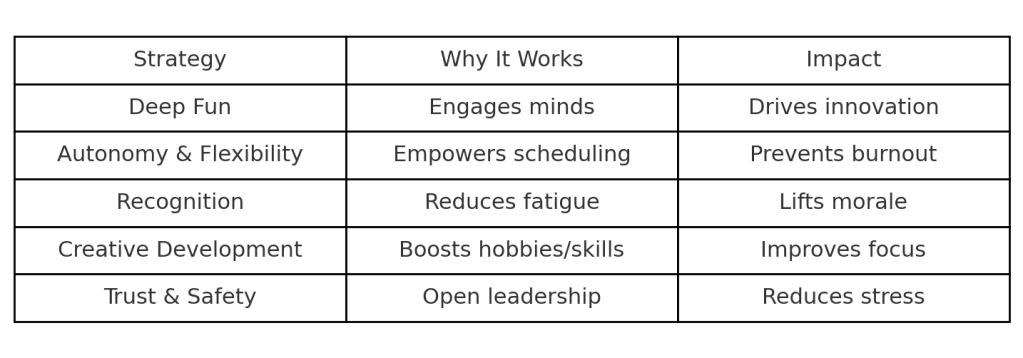
🔧 What You Can Do to Build a Less Stressful, More Productive Workplace
Here’s your action playbook to improve employee well-being, reduce stress, and drive results:
Final Word: Happy, Balanced Teams Win—Every Time

✅ Happy workers are 12–13% more productive
✅ They take fewer sick days, and stay longer
✅ They’re less stressed, more loyal, and more creative
Burnout isn’t a badge of honor—it’s a warning sign.
If your team is overwhelmed, disengaged, or anxious, it’s time to look at the culture—not just the workload.
You don’t need gimmicks to create a fun workplace. You need trust, purpose, communication, and flexibility.That’s what builds the kind of team that doesn’t just survive—but thrives.
📚 References & Sources
• Oswald, Andrew J., Eugenio Proto, and Daniel Sgroi. “Happiness and Productivity.” University of Warwick, 2014, https://warwick.ac.uk/newsandevents/pressreleases/new_study_shows/.
• Bryson, Alex, and George MacKerron. “Are You Happy While You Work?” Saïd Business School, University of Oxford, 2019, https://www.sbs.ox.ac.uk/news/happy-workers-are-13-more-productive.
• Gallup. “State of the Global Workplace: 2023 Report.” Gallup, 2023, https://www.gallup.com/workplace/349484/state-of-the-global-workplace.aspx.
• Harvard Business Review. “Creating a Happier Workplace Is Possible — and Worth It.” Harvard Business Review, 2022, https://hbr.org/2022/10/creating-a-happier-workplace.
• Gallo, Amy. “Employee Burnout: The Biggest Myth.” Harvard Business Review, 2021, https://hbr.org/2021/02/burnout-is-about-your-workplace-not-your-people.
• Inc. Staff. “The Surprising Science of Having ‘Fun’ at Work.” Inc., 2021, https://www.inc.com/melanie-curtin/the-surprising-science-of-having-fun-at-work.html.
• Tews, Michael J., et al. “Fun and Friendships in the Workplace: Do They Matter?” Journal of Vocational Behavior, vol. 76, no. 3, 2010, pp. 291–302. https://doi.org/10.1016/j.jvb.2009.11.002.
• Time Staff. “Creative Hobbies Can Boost Job Performance by 30%.” Time Magazine, https://time.com/5369581/creativity-work-performance/.
• HR Cloud. “The Power of Employee Recognition.” https://www.hrcloud.com/blog/employee-recognition-statistics.
 SILENT POWER
Leave a comment